

The Game of Thrones : AI Edition

The Realm, the Characters, and How to Survive the Winter

Previously, on the Game of Thrones : AI edition...
A dinner joke became a slide deck. A friend said he writes his own emails because they feel more authentic — and got called Ned Stark for it. Months later, the India AI Impact Summit arrived with $200 billion in pledges and world leaders on stage — and promptly descended into unmistakable Westerosi drama: two rival AI kings refusing to hold hands for a photo, a commercially available robot dog parading as in-house innovation, youth protesters detained outside while leaders spoke of AI uplifting the poor inside, and Bill Gates quietly vanishing before his own keynote. That's when I knew — this wasn't a joke anymore. The Game of Thrones of AI had already begun. Read the full origin story - https://www.wanderingsoul.in/post/how-a-dinner-joke-led-to-the-game-of-thrones-of-ai
Now. Let's talk about the realm itself.
The Iron Throne of Industry

"Brace yourselves. Winter is coming."
When Ned Stark first uttered those words, few understood what approached. The realm was too busy with its petty wars to notice the real storm gathering beyond the Wall. Automation is precisely this kind of storm. Already here, already reshaping the kingdoms of finance, healthcare, logistics, and the professional world with the quiet inevitability of a winter that was always meant to come. But before we go further — let's be honest about something. We have been here before.
The handloom weavers who watched power looms arrive and couldn't believe their craft would become obsolete. The telegraph operators who dismissed the telephone. The typographers who laughed at desktop publishing. Every technological revolution has produced the same cast of characters: the ones who adapt, the ones who resist, the ones who are simply swept away, and the ones who insist that this time is different — usually meaning they believe they are somehow exempt. We never learn. Not really.
There is a line from a Marathi historical drama that has stayed with me for years — one of those rare observations that cuts so cleanly it almost hurts:
""माणूस इतिहासातून फक्त एकच गोष्ट शिकतो, आणि ती म्हणजे — इतिहास त्याला काहीच शिकवत नाही. पण म्हणून त्या इतिहासाची पोथी बांधून माळ्यावर टाकली, तर त्याची पाने आपल्याला स्वतःच्या रक्ताने लिहावी लागतात...""
(Man learns only one thing from history, and that is—history teaches him nothing.But if, for that reason, you tie up the book of history and toss it into the attic...then you have to write its pages with your own blood.)
I know its bit dramatic and no I am not here to give you a history lesson. History lessons don't work — the quote just told us so. What I want to do instead is use something that feels historical, something with the sweep and the drama and the moral weight that history carries, without the lecture. Something like a saga. Something like, say, seven kingdoms tearing themselves apart over who sits on a throne made of swords.
Because if you want people to understand a revolution, sometimes the most honest thing you can do is tell it as a story.
Characters We Recognise
What makes Game of Thrones so enduring is not the dragons or the battles. It is the characters — flawed, striving, human — and our desperate need to see ourselves in them. The AI transformation offers us the same mirror.

Ned Stark is the traditional leader: principled, dependable, his entire identity woven into a system that no longer rewards integrity the way it once did. Many organisations, many workers are Ned right now — not villains, not failures, but people whose values outlast the systems that once sustained them. Their legacy matters. Ethics matter. Even if the game has changed.

Cersei Lannister is the giant — powerful, centralising, controlling the narrative with one hand while fending off regulators with the other. The ruthless consolidation of data, of markets, of influence. Power hoarded until it becomes its own undoing. I know, you could probably name a few Cerseis.
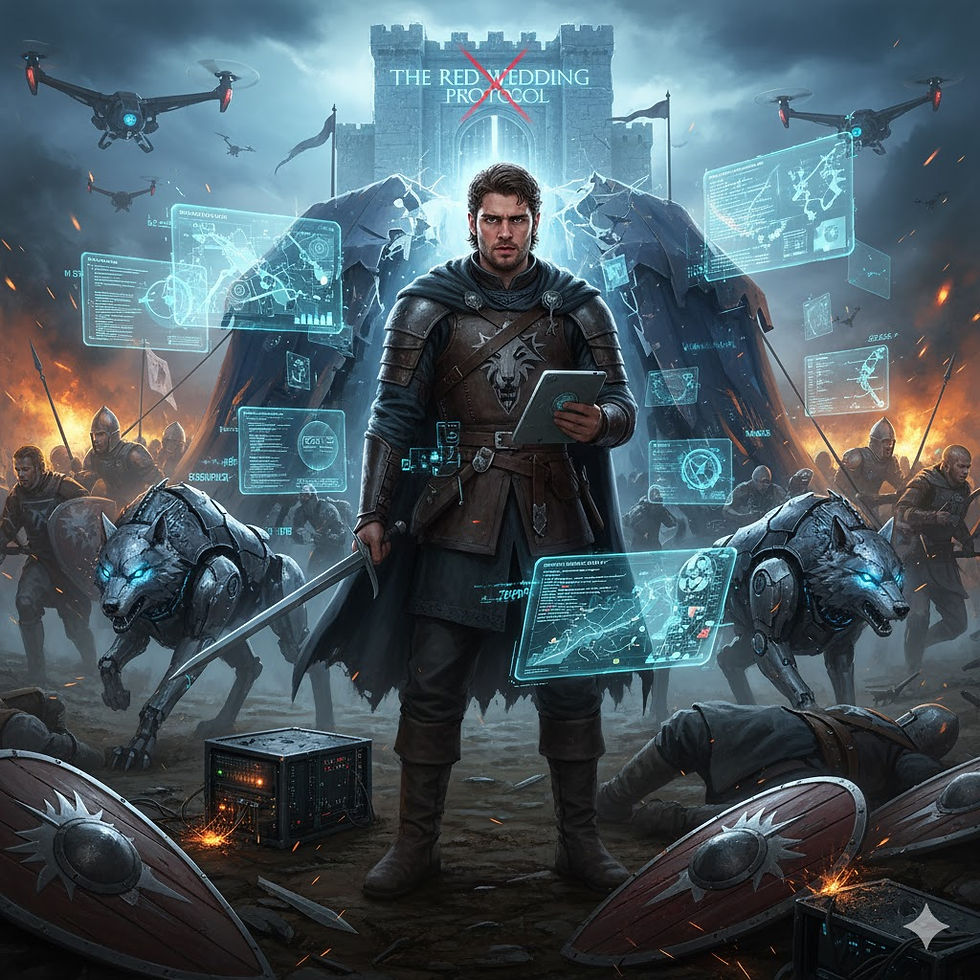
Robb Stark is the ambitious early adopter — moving fast, believing in the cause, but building on alliances too fragile to hold. How many AI companies & initiatives we have already we seen were launched with fanfare, only to collapse because the partnerships weren't sustainable, the foundations weren't solid? Promising starts. Avoidable ends.

Then there is Jon Snow — the forward-thinking professional who survives not because he is the cleverest, but because he is willing to adapt. He doesn't fight the change. He rides alongside it, earning the loyalty of humans and dragons alike. Adaptation and preparation win. They always do.

And Daenerys — the disruptive innovator, wielding extraordinary power, rising fast, burning bright. But power without wisdom is fire without direction. The lesson cuts deep: it is not enough to hold the dragon. You must understand it.
Dragons and Wolves — A Metaphor Worth Sitting With

In the mythology of Westeros, dragons are creatures of immense power — capable of liberation and destruction in equal measure. The AI systems arriving in our world are precisely this: extraordinary, boundless, and deeply in need of skilled human guidance.
The Starks, meanwhile, had their direwolves — loyal, intuitive, fiercely attuned to the emotional world. This is human intuition. Creativity. Ethical judgment. The quiet knowing that no algorithm, however sophisticated, has yet learned to replicate. The future belongs not to dragons alone, nor to wolves alone. It belongs to the alliance between them.
And so new roles are emerging from this union — roles that are not yet defined but are slowly shaping up.
The Architect & The Oracle
The AI Prompt Alchemist: Not just a "prompt engineer," but a weaver of intent. They transform raw human thought into the "gold" of machine execution, ensuring that the nuance of language is never lost in translation.
The Agentic Fleet Commander: The strategist who oversees multiple autonomous agents. They don't just manage tasks; they lead a "Great House" of digital entities, ensuring every agent remains loyal to the mission's core intent.
The Protectors & Philosophers
The Model Ethicist — The High Septon of Logic: The moral compass of the deployment. They ensure that the AI's "soul"—its training data and decision-making—remains untainted by bias and aligned with human virtue.
The Latent Space Explorer: The scout who ventures into the vast, multidimensional "wilds" of a model's knowledge. They map the unknown territories of an AI’s capabilities to find hidden shortcuts and potential dangers.
The Builders & Connectors
The Knowledge Graph Mason: The builder of the foundations. They ensure that the organizational "citadel" is built on structured, retrievable, and truthful data, preventing the "ruins" of hallucination.
The Human-Centric Interface Weaver: The tailor who ensures the AI doesn't feel like a cold machine. They design the "garments" of interaction, making sure the collaboration feels as natural as a conversation between old friends.
The new Citadel

Role | Moniker | Modern Focus |
The AI Strategist | The Hand of the King | Aligning AI goals with the vision. |
The Integration Lead | The Master of Coin & Connections | Managing the flow of data across AI systems and third-party APIs. |
The Cybersecurity Lead | The Warden of the North | Guarding the perimeter against adversarial attacks and leaks. |
The Feedback Loop Mgr | The Raven Master | Managing the constant flow of messages and corrections between user and machine. |
These are not consolation prizes for a disrupted workforce. These are the new seats of power.
Old Roles Die. New Legacies Begin.

Here is what the Game of Thrones AI Edition asks of us, in the end:
Not perfection. Not omniscience. Not the certainty of knowing exactly which dragon to ride.
It asks for preparation — the willingness to learn before the storm arrives, not after.
It asks for humility — the Jon Snow quality of knowing what you don't know, and building alliances accordingly.
It asks for ethics — because AI systems, like dragons, can become unpredictable. The questions of fairness, of bias, of human dignity are not footnotes to the technological story. They are the story.
And it asks for adaptability — that rarest and most human of gifts: the ability to look at a world utterly changed and find, somewhere within the wreckage of the familiar, a new way to belong.
Are You Ready for the Winter?
The wandering soul has always known this truth: the journey does not end when the road becomes difficult. The journey becomes the road.
Every civilisation that has survived a great disruption — whether fire or flood, invasion or revolution — has done so not by clinging to what was, but by understanding deeply enough what was valuable to carry it forward into what must be. The wisdom of those who built well, led ethically, adapted bravely: that is the legacy that endures. Not the throne. Not the crown.
But the character.
Winter is here. And the question is not whether you will be affected.
The question is 'who you will choose to be when the temperature drops?'


Comments