

Seven Habits of Highly Effective AI Users

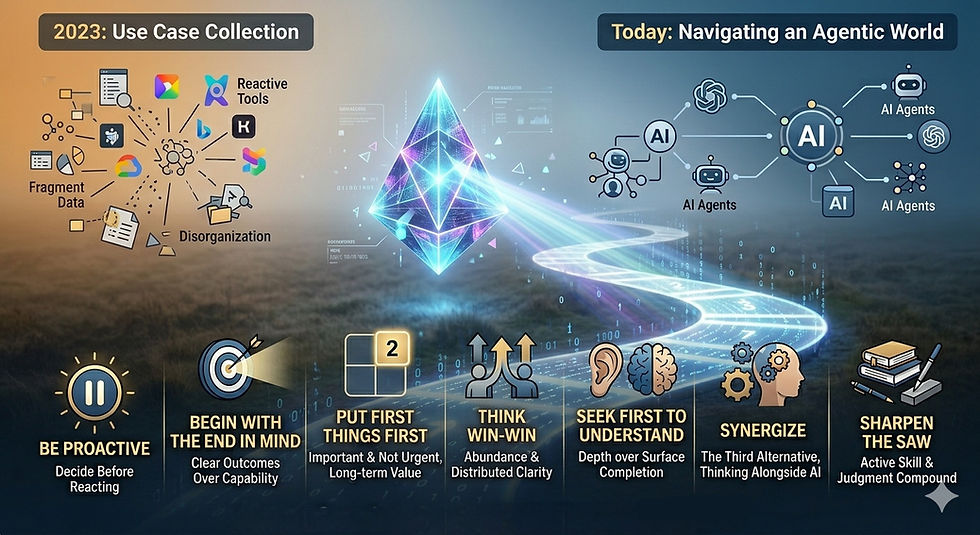
I was recently asked to present our adoption journey — how we went from collecting use cases in 2023 to navigating an agentic world today. While preparing, I found myself reviewing my own journey, not the company's. And it stopped me cold.
The people who actually thrived through this transition weren't the ones chasing every capability. They were the ones who stayed grounded in something bigger than the tools. And I realized I'd been watching that the whole time without naming it.
I've lived with Stephen Covey's seven habits of highly effective people longer than any of these tools have existed. If you know my work, you know I keep returning to that framework — not because it's trendy, but because it actually works. I've used it to understand every transition I've been through. This one is no different. Except now I'm watching others navigate it too, and the same patterns hold.
This isn't advice. It's what I learned watching myself, and others, go from use cases to agents. Here's what actually stuck.
1. Be Proactive.
Viktor Frankl wrote that between stimulus and response there is a space, and in that space lies our freedom. Covey built his first habit there.
The fast world rewards speed of reply. The responsive model rewards it more. What stands out is the person who pauses in that space — who decides whether to use the tool, what to bring to it, what to keep for themselves. Proactive AI use is not faster reaction. It is the deliberate refusal to react.
I got this one wrong early. I was reactive — jumping on every new model, every capability, letting the tools set my pace. It took a few months of spinning to realize: the moment I chose when to engage, instead of just responding to what was available, the work got better.
2. Begin with the End in Mind.
Every quarter brings a new model, a new agent, a new capability. The temptation is to chase the capability and let the outcome drift.
Stay with the outcome. What is this for? Who reads it, and what should change in them? When the end is clear, the choice between prompt, agent, model, or none becomes obvious. When the end is vague, you ship AI slop and call it productivity.
You will need to upgrade. The upgrade is in service of the end, not the other way around.
The hardest version of this is saying no. "This model is incredible, but it's not for what we're building right now." That sentence separates the people still searching from the people who know what they're looking for.
3. Put First Things First.
Priority \ Urgency quadrants are simple. Urgent and important is the fire. Urgent and unimportant is the noise. Important and not urgent is the quadrant where lives are actually built — long work, deep relationships, skills that compound, thinking that pays off years later.
Most AI use lives in the first two. Faster fires, faster noise.
The effective user pulls AI into quadrant two. Use it to build a capability you will still have next year. Use it to think through a problem you have been avoiding. Use it to make the long thing you have been meaning to make. The tool is at its best where today's metrics cannot find it.
Where is your AI use actually living? Be honest.
4. Think Win-Win.
This one is harder than it sounds because a model cannot want what you want.
Scarcity thinking says: use it before someone else does, extract every advantage, ship it and move. Abundance thinking says something different — that a tool amplifies what you already are. If you are generous, it makes you generously scaled. If you are extractive, it makes you extractively scaled, just faster.
The question is not whether the model wins. It doesn't care. The question is whether the people around what you make — your reader, your user, your team, your future self — end up better or worse off. Win-win is not about the tool. It is about the discipline of asking whether you are using capability or just velocity.
Organizations fracture on this one. The people who see AI as leverage for their position hoard it, optimize their workflows, become islands of productivity in a sea of uncertainty. The people who use it to distribute clarity, to lift others' thinking, to make hard work shareable — they become architects. The tool doesn't decide this. The habit does.
5. Seek First to Understand.
Covey's hardest habit. Most listening is waiting to reply.
Most AI use is the same. We brief the model and skim the output. The effective user moves slower in both directions — understanding what the model actually is before trusting it, and understanding their own work deeply enough to know what should not be delegated.
This is not romantic. It is practical. You cannot detect an error in something you haven't thought through. You cannot judge whether an answer is right if you don't know what right looks like. You cannot outsource what you have not sat with. The model is good at surface completion. It is only good at depth if you bring depth to it first.
There is another layer here — understanding the limits of understanding itself. The model does not know what it does not know. Neither do you. I'm still wrestling with this one. The discipline is staying curious about that gap, not pretending it is closed.
What is one thing you delegated that surprised you when you got it back?
6. Synergize.
The third alternative — the option neither party would have produced alone.
Most adoption stops short of synergy. Some refuse the tool and lose the leverage. Others hand it everything and lose the work. The middle, where you bring real thought and the model brings real range, is uncomfortable. It is also where the good work lives.
This is not collaboration. You cannot collaborate with a model. But you can think alongside it — build something neither of you would have built separately. The temptation is to resolve that discomfort by picking a side. Give it all to the machine and stop thinking. Or refuse the machine and stop scaling. Both are easier than the third way.
Are you refusing the tool, handing it everything, or staying in that uncomfortable middle?
The people who stay in that discomfort — who do the hard work of bringing real judgment to what an AI produces, who use the model to extend their thinking rather than replace it — they pull away. Their work gets better. Their teams learn from them. Their judgment, sharpened by the friction, becomes more reliable.
7. Sharpen the Saw.
The model gets sharper every quarter. The risk, quietly, is that you get duller.
It is easy to stop reading long books because summaries are faster, stop writing first drafts because the model will draft for you, stop holding a thought for a day because typing it is so cheap. Stop thinking in depth because shallow thinking gets amplified just fine.
The discipline here is active. Read what the model could not have written. Write when you could have delegated. Think through a problem without asking for help. Keep the skills the tool has made optional — not in spite of it, but because of it. Your judgment is the only part of this loop that compounds.
This is where the habits separate the people who stay effective from the people who get efficiently replaced. The tool makes some skills optional. It makes judgment more important, not less.
That's what I learned from the beginning of this journey to where we are now.
The habits that worked when the obstacles were calendars and meetings work now. They're just more important. Because the tools will keep changing — new models, new agents, new capabilities every quarter. But the person you become, the discipline you build, the judgment you sharpen — that compounds.
So here's what I'm asking myself now: as these tools keep evolving, What are you learning about yourself in all of this?


Comments